Outside Broadcast: When Your Cabling Can't Fail, Not Even Once
The infrastructure demands of live broadcast environments and why deployable fibre specification is not a place to compromise
In outside broadcast, there is no second take. When a live event goes on air, from Premier League matches to Formula 1 races and major awards ceremonies, the network infrastructure must perform. A fibre failure during transmission is not a technical inconvenience. It is a broadcast failure, visible to millions, with serious contractual and reputational consequences.
The Zero-Tolerance Environment
Outside broadcast is one of the most demanding operating environments for network infrastructure. Deployable fibre is installed and operational within hours of arrival on site. It runs across pitchside rigs, camera positions, outside broadcast vehicles, temporary production facilities and back-to-base links. It is exposed to foot traffic, vehicle movement, weather and the demands of rapid deployment and recovery across tightly scheduled events.
Cabling in broadcast environments cannot be standard studio or enterprise fibre. It must withstand repeated bending, connectorisation and deployment under time pressure. It must operate reliably from -20°C in outdoor winter conditions to elevated temperatures in indoor production areas. Connectors must mate reliably when engineers are working quickly, under pressure and often in poor light. There is no tolerance for optical loss caused by contamination, misalignment or physical damage.
Where Broadcast Fibre Failures Come From
The most common sources of failure in broadcast fibre deployments are connector contamination, inadequate cable construction and incorrect fibre type selection.
Connector contamination is the leading cause of fibre performance issues in any environment, but in outside broadcast it is particularly problematic. Deployable cables are repeatedly connected and disconnected across multiple events, with connectors exposed to dust, moisture and debris. Contamination introduces optical loss that degrades signal quality. In severe cases, it can cause link failure or physical damage to the connector end-face.
Cable construction is critical in deployable applications. Standard tight-buffered fibre is not designed for repeated flexing and mechanical stress. Broadcast-grade deployable cables use ruggedised construction, including tactical or military-specification jackets, reinforced with aramid yarn or steel wire, with connectors designed for field use rather than controlled rack environments.
Fibre type selection creates additional risk when not properly managed. Mixing multimode OM3, OM4 and singlemode links within the same broadcast infrastructure, without clear documentation, increases the likelihood of mismatched connectors and incorrect optics at the equipment end. In fast-paced deployments, this becomes a genuine operational risk.
The Solution: Specification Built for Broadcast Conditions
Broadcast fibre infrastructure should be specified for the environment in which it will operate, not adapted from products designed for other applications.
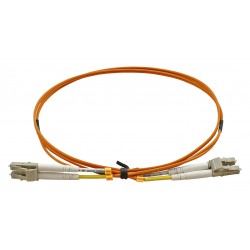
For outside broadcast, this means deployable fibre assemblies built to broadcast-grade specifications, with connectors matched to the equipment in use, typically LC, SC, ST or E2000 depending on the application. Pre-terminated assemblies, manufactured and tested to length, remove the variability and time constraints of field termination in live environments.
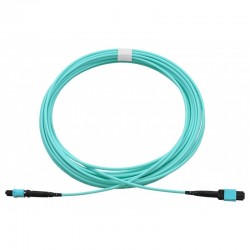
MPO systems are increasingly used in high-density broadcast environments where multiple fibres must be connected quickly at camera positions, patch bays and OB vehicles. MPO trunk cables with fanout harnesses provide the multi-fibre connectivity required for modern IP production workflows, while maintaining fast, reliable deployment.
Fibre cleaning and inspection should be standard practice. Every connection should be inspected before mating using a fibre inspection probe or video microscope. Contaminated end-faces should be cleaned before connection, not after performance issues appear. This discipline prevents a significant proportion of broadcast link failures.
Planning for Rapid Deployment
Outside broadcast schedules leave no margin for sourcing delays. Cables, connectors, patch panels and breakout enclosures must be available before the event window opens, not ordered once deployment has started. For contractors working across a season of events, maintaining stock of standard deployable assemblies, or partnering with a supplier capable of fast turnaround, is essential.
Connectix has supported broadcast projects across the Olympic Games, FIFA World Cup, FA Premier League, Formula 1 and Grand Slam tennis, working with systems integrators and contractors in the UK and internationally. The Connectix broadcast range includes deployable harsh environment fibre assemblies, MPO systems, breakout enclosures and active equipment, designed and manufactured for live broadcast demands.
You can find out more how we can support broadcasting here.