The Importance of Airflow in High-Density Cabinets
A cabinet that is full of equipment and poorly ventilated is not a high-density installation. It is a thermal problem waiting to become a network problem.
The push towards higher port density in data cabinets and server racks has been consistent and sustained. More switching equipment, more patch points, more active hardware in the same or smaller footprint. The economics are straightforward - floor space costs money in a data centre, and rack space is finite in a communications room. Fitting more into less is a legitimate engineering objective.
But density without airflow management is a false economy. Heat is the primary cause of premature hardware failure in active network equipment. It degrades performance before it causes outright failure, often in ways that are difficult to diagnose without thermal monitoring. And in a high-density cabinet, the conditions that allow heat to accumulate are easier to create than most installers and facilities teams appreciate.
Understanding airflow - how it moves, where it stalls, and what happens when it does - is fundamental to any installation where active equipment and high port counts share an enclosure.
Why Heat Is the Problem It Is
Electronic components generate heat as a by-product of normal operation. Switches, servers, patch equipment with active components and power distribution units all contribute to the thermal load inside a cabinet. At low densities, ambient room cooling is usually sufficient to manage that load without intervention. As density increases, the heat generated per unit of rack space rises, and passive cooling becomes inadequate.
Most active network equipment is designed to operate within a defined temperature range. Manufacturers publish maximum inlet air temperatures, and equipment running consistently above those figures will experience shortened component life, increased error rates and, eventually, thermal shutdown. The damage is cumulative. Equipment that has been running hot for eighteen months does not recover full operational life when the airflow problem is eventually addressed.
The relationship between temperature and failure rate in electronic components is well established. For many semiconductor devices, every ten degree Celsius rise in operating temperature roughly doubles the failure rate. In a high-density cabinet where inlet temperatures are running ten or fifteen degrees above the design point because airflow has not been managed, that is not a theoretical risk, it is an accelerated path to hardware replacement and unplanned downtime.
How Airflow Works in a Cabinet
Most active network equipment is designed around a front-to-rear airflow path. Cool air is drawn in at the front of the equipment, passes across the components that need cooling, and is exhausted at the rear. The cabinet design and the room cooling strategy need to work with that airflow path, not against it.
In a correctly configured installation, cool air enters the front of the cabinet, passes through the equipment, and exhausts at the rear into a hot aisle or directly to a return air path. The temperature differential between the inlet and exhaust air is a function of the heat load and the volume of airflow. Where that differential is large, the equipment at the back of the airflow path (typically the exhaust side) is working harder to maintain acceptable component temperatures.
Problems arise when that airflow path is interrupted, diverted or reversed. Blanking panels missing from empty rack units allow hot exhaust air to recirculate from the rear of the cabinet back to the front, mixing with the cool supply air and raising inlet temperatures across every unit in the rack. Cable bundles routed across the front of equipment obstruct the air intake. Poorly dressed patch leads reduce the effective open area at the front of the cabinet, restricting the volume of cool air that can reach the equipment.
In a lightly loaded cabinet, these problems are largely self-correcting because there is enough thermal headroom to absorb the inefficiency. In a high-density installation, there is no headroom. Every percentage point of airflow restriction has a measurable effect on inlet temperature, and inlet temperature determines how hard the equipment's internal fans have to work to maintain safe operating conditions.
Blanking Panels: The Most Overlooked Detail
Blanking panels are one of the most cost-effective airflow management tools available, and they are consistently underused. Their function is simple: they close off empty rack units so that the pressure differential between the cool front of the cabinet and the warm rear cannot drive hot air recirculation through the gaps.
In a fully populated cabinet, blanking panels are not needed because there are no gaps. In the real world, cabinets are rarely fully populated from day one. Phased deployments, equipment changes and the natural evolution of a network over time mean that empty rack units exist in almost every live cabinet. Each one without a blanking panel is a path for hot exhaust air to return to the inlet side.
The thermal effect of missing blanking panels is not evenly distributed. Units directly above and below an empty, unblanketed gap are most affected, because the recirculating air is hottest nearest the gap. In a high-density switch stack, a single unblanketed gap in the middle of the run can raise inlet temperatures for the equipment on either side by several degrees — enough to push borderline installations into regular thermal events.
Fitting blanking panels costs almost nothing relative to the hardware being protected. Removing and refitting them when equipment is changed takes minutes. There is no credible reason to leave rack units open in a live cabinet.
Cable Management and Airflow
Cable management in a high-density cabinet is not purely an aesthetic concern. The way patch leads and power cables are routed through and around active equipment directly affects the airflow available to that equipment.
Patch leads that are too long get looped and bundled in the space in front of the equipment. A dense bundle of cables across the front of a switch obstructs the air intake in the same way that a partially blocked grille obstructs a fan. The equipment compensates by running its internal fans faster, which increases power consumption, increases noise and reduces fan life.
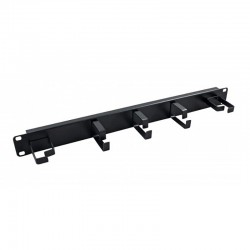
Vertical and horizontal cable managers provide the structure to route cables cleanly past equipment intakes rather than across them. Correctly sized patch leads ordered to the length actually required rather than a standard length that leaves excess to be managed, reduces the volume of cable that needs to be accommodated in the front of the cabinet. They are a practical tool for maintaining the airflow the equipment was designed to receive.
Power cables carry the same risk. A power distribution unit installed at the rear of a cabinet with cables routed across the rear exhaust of equipment restricts the hot air path out of the rack, raising exhaust back-pressure and reducing the effectiveness of the equipment's internal cooling.
Cabinet Selection and Specification
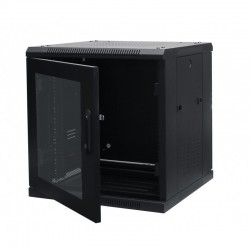
The cabinet itself contributes to airflow performance in ways that become significant at high densities. Perforation patterns on front and rear doors, the percentage of open area in side panels, the internal depth relative to the equipment being housed and the provision for top and bottom cable entry all affect how freely air can move through the enclosure.
A cabinet specified for low-density general use may have a front door perforation that is adequate for light loading but becomes a restriction at high density. Manufacturers publish open area percentages for cabinet doors and panels, and these figures matter when the cabinet is expected to handle significant heat loads. A front door with 60 to 65 percent open area gives equipment fans substantially more air to work with than one with 40 percent, at no additional noise penalty.
Cabinet depth is a related consideration. Equipment with rear-exhaust fans needs sufficient space between the back of the equipment and the rear door to allow hot air to exit freely. Packing a deep switch into a shallow cabinet, or over-filling the rear cable management space with patch leads, restricts that exhaust path and raises operating temperatures across the whole unit.
For the highest density installations, in-row cooling, rear-door heat exchangers or direct liquid cooling may be the appropriate solution rather than relying on room-level air conditioning to manage the load. These are specification decisions that need to be made before the cabinet is populated, not after the first thermal shutdown.
Monitoring and Ongoing Management
Airflow management is not a one-time decision made at installation and then left unchanged. Cabinets evolve. Equipment is added, removed and replaced. Patch leads are changed. Blanking panels are removed to install equipment and occasionally not replaced. The thermal performance of a cabinet at handover may be quite different from its thermal performance two years into operation.
Temperature monitoring inside cabinets - at the top, middle and bottom of the rack, and separately at the inlet and exhaust - provides the information needed to identify developing thermal problems before they cause hardware failure. Intelligent power distribution units with environmental monitoring can provide this data continuously and alert facilities teams to temperature excursions before they become service-affecting.
A visual inspection of blanking panel coverage, cable management and front-of-cabinet airflow obstruction should be part of any routine maintenance visit. It takes minutes and can identify problems that would otherwise only be discovered when equipment fails.
Getting It Right From the Start
The decisions that determine airflow performance in a high-density cabinet are made at the specification and installation stage. Cabinet selection, blanking panel specification, cable management strategy and the choice of correctly-sized patch leads all need to be considered together, as part of a coherent approach to thermal management, rather than addressed individually as afterthoughts.
Connectix supplies a comprehensive range of data and server cabinets, cable management solutions, blanking panels and custom-length patch leads designed to support high-density installations. The Connectix technical team can support for projects where density, airflow and thermal management are design considerations.
If you would like to discuss cabinet specification, cable management or any aspect of your project, get in touch.
📞 01376 346600 | 📨 sales@connectix.co.uk